ESPR Explained: The Ecodesign for Sustainable Products Regulation
The ESPR is the single most important product law the EU has passed in a generation — the legal engine behind the Digital Product Passport and the coming wave of product-level sustainability requirements. Here is how it actually works.
In 30 seconds
- •What: framework law for product sustainability — performance + information (DPP) requirements
- •Scope: nearly all physical goods on the EU market — including imports
- •Mechanism: product-group delegated acts define concrete requirements
- •In force: 18 July 2024; first delegated acts from 2026
What the ESPR is
ESPR — Regulation (EU) 2024/1781
A regulation establishing a framework for setting ecodesign requirements for sustainable products — covering their durability, reliability, reusability, repairability, recycled content, carbon and environmental footprint, and the information made available about them through the Digital Product Passport.
The ESPR is the successor to the 2009 Ecodesign Directive — with two decisive upgrades. First, scope: the old directive covered energy-related products only; the ESPR covers nearly all physical goods. Second, mechanism: alongside classic performance requirements, the ESPR introduces the Digital Product Passport as a general information instrument.
It is deliberately a framework, not a rulebook. The ESPR itself does not set the repairability score for a sneaker or the recycled-content floor for an aluminium profile — it defines the parameters from which such requirements can be chosen, and the procedure by which they become law for each product group.
What products it covers
The ESPR applies to any physical good placed on the EU market, whether made in the EU or imported — with a closed list of exclusions:
- Food, feed and agricultural/fisheries products
- Medicinal products for human and veterinary use
- Living plants, animals and micro-organisms
- Products of human origin
- Most vehicles covered by sector-specific type-approval law
- Products related to defence or national security
Everything else — textiles, electronics, furniture, tyres, iron, steel, aluminium, chemicals, toys, construction products — is in principle in scope. In practice, obligations arrive only when your product group is covered by a delegated act or by sector legislation that adopts the DPP mechanism.
The two mechanisms
1. Performance requirements
Article 5 requirements on the product itself: minimum durability, repairability scores, recycled-content floors, caps on substances of concern, energy/resource efficiency, remanufacturing-readiness. These change how products are designed and made.
2. Information requirements
Article 9–13 requirements on what must be disclosed — primarily through the Digital Product Passport. This changes what product data must exist, be structured, and be accessible across the value chain.
A delegated act can impose one or both. A product group might get performance requirements without a DPP, a DPP without new performance floors, or both together — determined product group by product group.
The anatomy of the regulation
The ESPR is a substantial law — 79 articles plus annexes. A mental map of where things live makes it far easier to navigate:
| Chapter | Articles | What it covers |
|---|---|---|
| I — General provisions | Art. 1–8 | Scope, definitions (incl. the Art. 2(28) DPP definition), empowerment for delegated acts, ecodesign requirements |
| II — Ecodesign requirements | Art. 4–8 | Performance and information requirements, the parameter menu, delegated-act procedure |
| III — Digital Product Passport | Art. 9–15 | The DPP itself — requirements, technical design, data carriers, unique identifiers, the Registry, customs control |
| IV — Labels & unsold goods | Art. 16–25 | Labelling rules, the destruction-of-unsold-goods prohibition and disclosure duties |
| V — Conformity | Art. 26–46 | Conformity assessment, CE marking, declaration of conformity, notified bodies |
| VI — Obligations of operators | Art. 27+ | Manufacturer/importer/distributor/dealer duties, authorised representatives, online marketplaces |
| VII–IX — Governance & enforcement | Art. 47–79 | Green public procurement, market surveillance, penalties, the Ecodesign Forum, committee procedure, reporting |
For DPP work specifically, Chapter III (Articles 9–15) is the operative core — it is where the passport, its data carriers, identifiers, Registry and customs interface are legally defined.
Annex III: the menu of sustainability parameters
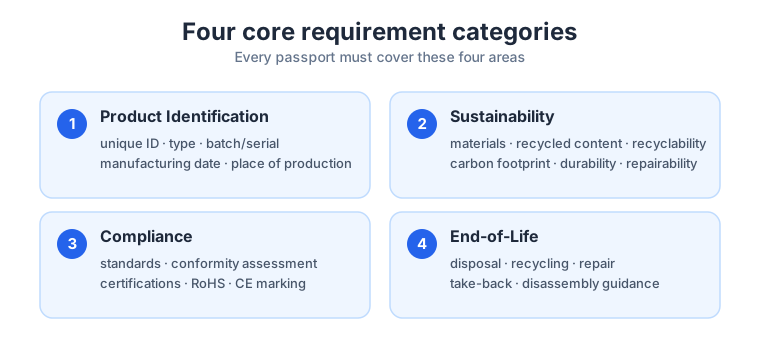
When the Commission drafts a delegated act, it selects from the parameters in Annex III. These are the dimensions on which products can be regulated:
For a DPP, these parameters become data attributes: the delegated act specifies which information must be provided, for which parameters, at which granularity — and which slice is public versus restricted.
How delegated acts work — the procedural reality
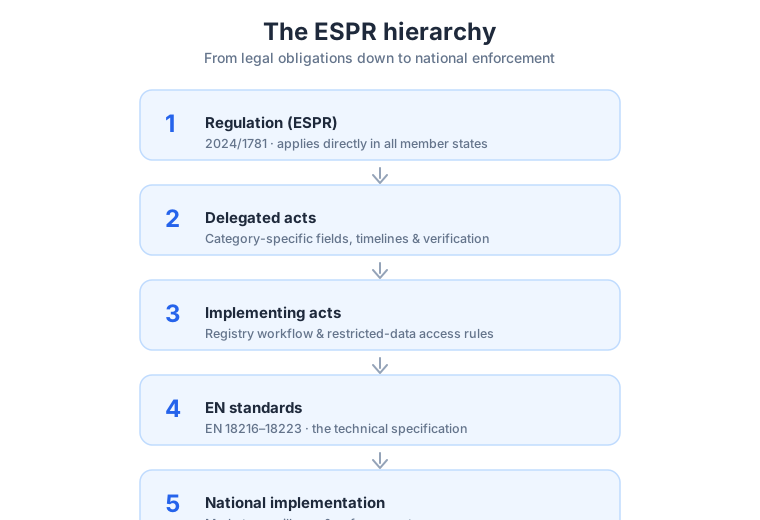
Working plans (published roughly every three years) list the product groups the Commission intends to regulate, with indicative timing. For each group, the Commission drafts a delegated act, runs consultations through the Ecodesign Forum — a stakeholder body with industry, NGOs and Member States — and adopts it. Parliament and Council get a two-to-four-month objection window; they can veto but not amend.
Each act then sets an application date, typically ~18 months after adoption — the real deadline for that product group. Separately, implementing acts handle machinery: registry operation, labelling detail, conformity-assessment procedures.
The destruction-of-unsold-goods ban
The ESPR's most immediate provision has nothing to do with passports: a ban on destroying unsold apparel, clothing accessories and footwear, applying to large enterprises from 19 July 2026 (medium-sized enterprises follow six years later). Alongside it, a transparency obligation (Article 24) requires covered companies to disclose publicly — on their website — how many unsold products they discard and destroy.
For fashion and retail businesses this is already a live obligation with a date — arriving before the first textile DPP — and an early signal of how the ESPR will be enforced in practice.
Substances of concern — the concept that reaches into every passport
One ESPR concept quietly shapes most product passports: substances of concern. These are substances that meet defined hazard criteria or that negatively affect reuse and recycling — the definition is deliberately broader than the REACH "substances of very high concern" list, because the ESPR cares about circularity, not only toxicity.
For each covered product, delegated acts can require the DPP to carry substances-of-concern information: the substance name, location in the product, and concentration — plus, where needed, safe-use instructions. This serves two distinct audiences:
- Consumers and the market — transparency about hazardous content in a product they are buying.
- Recyclers and remanufacturers — the information needed to handle the product safely at end-of-life, which is why this data sits in the restricted tier rather than always being public.
Practically, substances-of-concern reporting is what turns a passport from a marketing-facing label into a genuine circular-economy instrument — and it is a data obligation that frequently forces a bill-of-substances discipline many manufacturers do not currently maintain at component level.
Who is obligated
The ESPR distributes duties across the value chain — the same actor model the DPP inherits:
| Actor | ESPR obligation |
|---|---|
| Manufacturer (EU or non-EU) | Ensure the product meets performance + information requirements; draw up technical documentation and the EU declaration of conformity; create the DPP where required |
| Importer | Place only compliant products on the market; assume manufacturer-equivalent duties for third-country goods |
| Distributor / dealer | Act with due care; verify conformity markings, documents and — where required — the data carrier |
| Online marketplaces / fulfilment providers | Covered by distance-sales provisions; cooperate with surveillance; designate contact points |
Enforcement
Conformity is asserted through CE marking and the EU declaration of conformity, backed by technical documentation. Market surveillance authorities can run documentary, physical and laboratory checks, order corrective actions, withdrawals and recalls. Member States must set penalties that are effective, proportionate and dissuasive.
The structural shift the DPP introduces: surveillance moves from sampling documents after suspicion to machine-checking registration and data at the border — enforcement becomes systematic rather than episodic.
How the ESPR relates to adjacent laws
| Instrument | Relationship to ESPR |
|---|---|
| Battery Regulation 2023/1542 | Sector law that created the first DPP (battery passport) — interoperates with the ESPR framework |
| Construction Products Regulation | Revised CPR adopts the DPP mechanism for construction products |
| CSRD / ESRS | Company-level reporting; ESPR governs product-level requirements and information |
| REACH | Chemical substance law; ESPR delegated acts can restrict substances of concern at product level |
| CE marking regime | ESPR requirements are enforced through the standard conformity/CE system |
Frequently asked questions
Master the ESPR systematically
The CDPF Foundations certification walks through the ESPR, delegated acts, the DPP system and its data architecture in a structured ~4-5 hour course. First two chapters free.
Explore CDPFRelated: the battery passport · the EN 182xx standards