EU Digital Product Passport Timeline: Which Products, When
The DPP is not one deadline — it is a rolling programme of product-group obligations through 2030. This is the complete timeline: every date that matters, what triggers it, and how to work backwards from yours.
In 30 seconds
- •First hard deadline: 18 February 2027 — battery passport (Battery Regulation)
- •Framework: ESPR (EU 2024/1781) — obligations activate per product group via delegated acts
- •Next groups: iron/steel (2026), textiles/tyres/aluminium (2027), furniture (2028), mattresses/ICT (2029)
- •Reality: obligations bite ~18 months after each delegated act — but readiness work takes longer
The master timeline
| When | Milestone | What it means for business |
|---|---|---|
| Jul 2024 | ESPR (EU) 2024/1781 enters into force | The legal machinery for DPP exists; framework rules are fixed |
| Apr 2025 | First ESPR working plan published | Priority product groups confirmed — you can map portfolio exposure |
| 2026 | EN 182xx harmonised standards cited in the OJ | Technical rulebook is stable; building to the standards gives presumption of conformity |
| 2026 | DPP Registry becomes operational | Registration infrastructure is live; pilot registrations possible |
| 2026 | First ESPR delegated acts (iron & steel) | Clock starts for the first non-battery sector |
| Jul 2026 | ESPR ban on destroying unsold apparel/footwear applies (large enterprises) | Adjacent circularity obligations arrive before most DPPs do |
| 18 Feb 2027 | Battery passport mandatory | First hard DPP deadline; customs and market surveillance enforcement live |
| 2027–2029 | Textiles, tyres, aluminium, furniture, mattresses, ICT delegated acts | Rolling wave of obligations across the highest-volume product groups |
| 2030+ | Successive working plans extend coverage | DPP becomes the default product-information layer for the EU market |
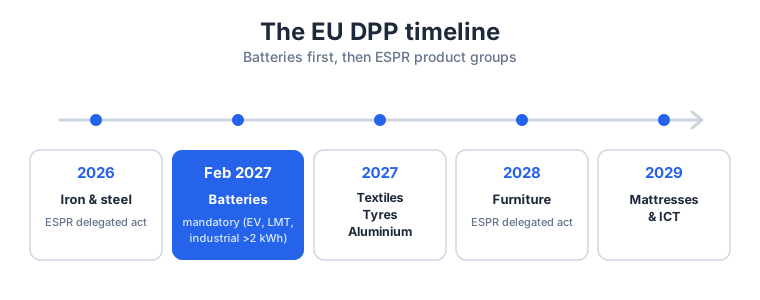
Product groups and expected dates
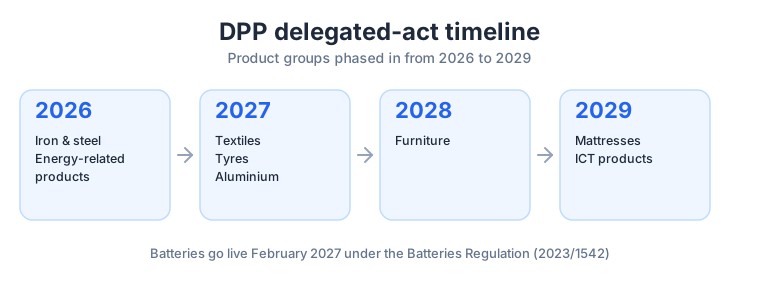
The Commission's ESPR working plan sets out the indicative sequence. Dates mark when delegated acts are expected — the obligation itself follows after each act's transition period:
| Product group | Indicative delegated act | Route |
|---|---|---|
| Batteries (EV, industrial >2 kWh, LMT) | 18 February 2027 (hard date in law) | Battery Regulation, Art. 77 |
| Iron & steel | 2026 | ESPR delegated act |
| Energy-related products | 2026–2029 (rolling) | ESPR delegated acts |
| Textiles / apparel / footwear | 2027 | ESPR delegated act |
| Tyres | 2027 | ESPR delegated act |
| Aluminium | 2027 | ESPR delegated act |
| Furniture | 2028 | ESPR delegated act |
| Mattresses, ICT products | 2029 | ESPR delegated acts |
| Construction products | Per revised CPR rollout | Sector legislation (CPR) |
| Toys, detergents, packaging | Per sector legislation revisions | Sector legislation |
The infrastructure milestones that matter as much as the dates
The DPP Registry
The EU-level Registry is being stood up with the first delegated acts (~2026). It stores identifiers and registration metadata and issues the URI used for automated customs checks on imports. When it goes live, registration becomes a testable, real system — not a spec.
Cited harmonised standards
The first six EN 182xx standards were cited in the Official Journal via Implementing Decision (EU) 2026/1736 — EN 18216 (exchange), 18219 (identifiers), 18220 (carriers), 18221 (storage), 18222 (APIs), 18223 (interoperability). Two more — prEN 18239 and prEN 18246 — are in finalisation. Cited status means the technical target is now stable enough to build against.
Service-provider ecosystem
DPP service providers — companies that host passport data on behalf of operators — are emerging to meet EN 18221 persistence requirements. The build-vs-buy decision is one of the earliest architecture choices your programme will face.
How transition periods actually work
Each delegated act carries an application date separate from its adoption date. The ESPR requires a reasonable transition — in practice around 18 months — before obligations apply. So a delegated act adopted mid-2026 for iron and steel would typically apply in late 2027 or 2028.
The trap is treating adoption as "plenty of time." Unit-level identifier strategy, data-quality remediation across ERP/PLM/spreadsheets, supplier data agreements, platform selection and pilot-to-scale deployment are each measured in months to years for a real portfolio. Organisations that wait for the act routinely spend the transition period discovering they needed it for implementation, not preparation.
How a delegated act actually becomes an obligation
Understanding the pipeline matters because each stage is a real signal of timing — and a point where dates can move:
| Stage | What happens | Rough duration |
|---|---|---|
| Working plan | Commission publishes the list of priority product groups and indicative sequence | Updated ~every 3 years |
| Drafting + consultation | JRC and Commission develop the act; the Ecodesign Forum and public consultations feed in — impact assessment runs in parallel | 12–24 months |
| Comitology scrutiny | Member-State experts review the draft; the act is refined | Months |
| Adoption | Commission formally adopts the delegated act — it is now law | Adoption date |
| Parliament/Council objection | Two-month window (extendable to four) for objection; either can veto but not amend | 2–4 months |
| Application | The act applies — obligations bind from the application date it sets | Typically ~18 months after adoption |
The practical takeaway: an "expected 2027" date in a working plan means the act is expected in 2027 — with application typically ~18 months later. Track the adoption date, not the working-plan date, to compute your real deadline.
The signals worth monitoring
Rather than tracking a single calendar, watch the publications that move dates. Each of these is a real, observable event that either confirms or shifts your planning horizon:
Official Journal entries
Delegated-act adoptions and standard citations are published in the OJ — the definitive legal trigger. An adoption notice is the event that starts your ~18-month clock.
ESPR working-plan updates
The Commission's rolling working plan reprioritises product groups — a group moving up or down the list is the earliest signal your sector's date is shifting.
Ecodesign Forum & consultations
Public consultations and Forum meetings preview an act's scope months before adoption — the cheapest early-warning system available.
JTC 24 & prEN publications
New prENs and OJ citations (like (EU) 2026/1736) define the technical spec you must build to — and prEN 18239/18246 completion will close the security gap.
The discipline is simple: fix your deadline off the OJ adoption date, and use the earlier signals to re-plan before it is formally set. Teams that anchor on working-plan dates routinely discover they have less runway than they assumed.
What could shift these dates
Working-plan dates are indicative, not promised: delegated acts require comitology scrutiny, consultations and — where relevant — European Parliament/Council objection windows. Product-group sequencing can be re-prioritised in successive working plans, and prEN standards timelines can slip the access-control and authentication layer.
What will not change: the battery passport's 18 February 2027 date, which is written into the Battery Regulation itself, and the direction of travel — the DPP is the EU's chosen product-information infrastructure, and coverage will only expand.
Work backwards from your date
For each product line, the planning question is the same: expected obligation date minus the time your data and systems actually take. If textiles is your group, a 2027 delegated act with an ~18-month transition implies real obligations around 2028–2029 — and a programme that should already be in flight now.
The organisations positioned best are not those watching dates most closely — they are those who already fixed identifiers, data quality and supplier contracts, so any delegated act is a compliance exercise, not a fire drill.
Frequently asked questions
Understand the regulation end-to-end
The CDPF Foundations certification covers the ESPR framework, delegated acts, the Registry and rollout in structured depth — ~4-5 hours, first two chapters free.
Explore CDPFBack to the complete DPP guide.