The EU Battery Passport Explained: Requirements, Data and the 2027 Deadline
The battery passport is the first Digital Product Passport with a binding compliance date. Here is exactly what it must contain, which batteries it covers, who is responsible, and what to do before February 2027.
In 30 seconds
- •What: a digital record for every EV battery, industrial battery >2 kWh, and LMT battery sold in the EU — Article 77 of Regulation (EU) 2023/1542
- •When: mandatory from 18 February 2027
- •How: accessed via a QR code on the battery; data hosted decentrally by the manufacturer or importer
- •Stakes: no conforming passport → the battery cannot be placed on the EU market
What is the battery passport?
Battery Regulation 2023/1542, Article 77
From 18 February 2027, every LMT battery, industrial battery with a capacity greater than 2 kWh, and electric vehicle battery placed on the market or put into service shall have an electronic record — the battery passport.
The battery passport is a digital record linked to an individual battery through a QR code. It carries information about the battery's identity, composition, carbon footprint, recycled content, supply-chain due diligence, performance, and end-of-life handling — with different slices of that data visible to consumers, recyclers, repair professionals, and regulators.
Batteries were chosen as the first DPP for a reason: they sit at the intersection of the energy transition, critical raw-material dependencies, and serious end-of-life risks. The EU wants traceability of cobalt, lithium, nickel and lead through the value chain; proof of carbon footprint and recycled content claims; and the information recyclers need to recover materials safely. The passport delivers all three.
Strategically, it is also the template. The Commission has confirmed the battery passport will integrate into the broader DPP system under the ESPR — which makes 2027 both a compliance deadline and a live preview of what every other product group will face.
Which batteries need a passport
| Battery category | Examples | Passport required? |
|---|---|---|
| Electric vehicle (EV) batteries | Traction batteries for cars, vans, trucks | Yes — from 18 Feb 2027 |
| Industrial batteries > 2 kWh | Stationary storage, UPS, industrial machinery batteries | Yes — from 18 Feb 2027 |
| LMT batteries | E-bikes, e-scooters, e-mopeds | Yes — from 18 Feb 2027 |
| Portable batteries | AA cells, phone/laptop batteries ≤ 5 kg | No (other rules apply) |
| SLI batteries | Car starter/lighting/ignition batteries | No |
| Industrial batteries ≤ 2 kWh | Small industrial cells | No |
If your portfolio sits near a boundary — a 2.1 kWh industrial pack, a battery inside an e-bike — classify carefully. "Placed on the market or put into service" covers both sale and own-use installations, and batteries incorporated into products count individually, not just standalone packs.
What data the passport must contain
Annex XIII of the Battery Regulation specifies the dataset. It is deliberately tiered — not everything is public:
Identity & manufacture
Unique battery identifier, model, manufacturer name and facility, manufacturing date and place, battery category and chemistry.
Materials & critical raw materials
Material composition, presence of cobalt, lithium, nickel, lead and other critical raw materials, hazardous substances.
Carbon footprint
Declared lifecycle carbon footprint per kWh of total energy provided, plus the carbon footprint performance class the battery falls into.
Recycled & renewable content
Share of recycled cobalt, lithium, nickel and lead, plus the share of renewable content — the data behind the Regulation's mandatory recycled-content targets.
Performance & durability
Rated capacity, expected lifetime under reference conditions, state-of-health metrics for EV and industrial batteries, charging parameters.
Circularity & end of life
Safe dismantling and disassembly information for recyclers, repurposing status, collection and recycling guidance, separate-collection symbols.
The carbon-footprint field is regulated, not free-form
The battery passport's carbon footprint is one of the most tightly specified fields. EV batteries over 2 kWh must declare a carbon footprint calculated per the JRC-developed methodology, and the declaration progresses through defined stages before it binds:
| Stage | What is required |
|---|---|
| Declaration | A carbon-footprint value per lifecycle stage, calculated to the delegated methodology and third-party verified |
| Performance class | The battery is assigned to a carbon-footprint performance class — the field consumers and procurers compare |
| Maximum threshold | Delegated acts will set lifecycle carbon-footprint maximums; batteries exceeding them cannot be placed on the market |
This is a progression most teams miss: the passport does not just display a footprint — it is the vehicle through which a voluntary declaration becomes a market-access condition. The data field is the enforcement mechanism.
On top of this sit the due-diligence records (supply-chain risk management for cobalt, natural graphite, lithium and nickel sourcing) and compliance evidence — test reports and conformity documentation for the CE-marked requirements the battery must meet.
The recycled-content obligations behind the data
The recycled-content fields in the passport are not decorative — they are the reporting mechanism for the Regulation's binding recycled-content targets. From 18 August 2031 industrial, EV and SLI batteries must contain minimum shares of recycled material, rising again in 2036:
| Material | From Aug 2031 | From Aug 2036 |
|---|---|---|
| Cobalt | 16% | 26% |
| Lithium | 6% | 12% |
| Nickel | 6% | 15% |
| Lead | 85% | 85% |
The passport's recycled-content declaration is how these percentages are evidenced — which means the data fields exist to serve enforceable targets, not just transparency.
The four access tiers
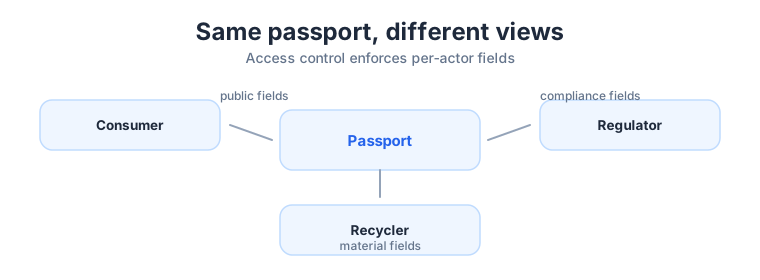
The battery passport is the clearest example of the DPP's tiered-access design. Annex XIII assigns each data attribute to an audience:
| Access level | Who | Typical data |
|---|---|---|
| Public | Anyone scanning the QR code — consumers, buyers | Identity, chemistry, carbon footprint declaration + class, recycled content, durability, end-of-life symbols |
| Legitimate interest | Recyclers, repurposers, repair professionals, secondary-market actors | Detailed composition, disassembly instructions, dismantling information, safety information |
| Notified bodies & authorities | Market surveillance, customs, the Commission, certification bodies | Test reports, conformity evidence, due-diligence records, full dataset |
| Battery management / owner | Battery owner or operator (e.g. fleet, storage operator) | Real-time state of health and state of charge data for EV and industrial batteries |
How it works in practice
Assign a unique battery identifier
Each individual battery gets a unique identifier — not per model, per unit. The identifier encodes manufacturer and battery identity.
Assemble and structure the data
The manufacturer compiles the Annex XIII dataset — sourcing data from cell suppliers, carbon-footprint studies, bill of materials, test reports — and structures it to the required model.
Host and register
Data is hosted by the economic operator or a service provider; the passport is registered so authorities and intermediaries can locate the authoritative record.
Issue the QR code
A QR code encoding the identifier is printed or engraved on the battery (or packaging/documents where the design does not permit). Scanning resolves to the passport.
Maintain through life — and beyond
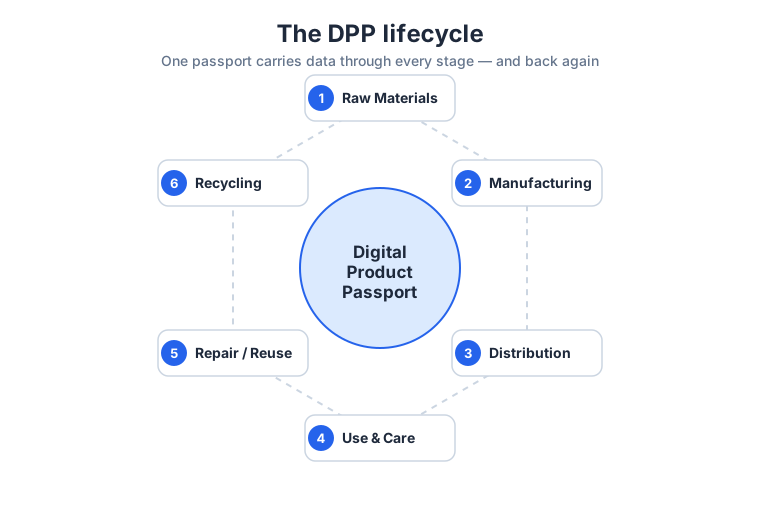
State-of-health data updates for EV/industrial batteries; at repurposing, a new passport is created and linked to the original, preserving chain of custody into second life.
Who is responsible
Responsibility sits with the economic operator placing the battery on the market: the manufacturer for EU production; the importer for batteries manufactured outside the EU. Importers are fully in scope — there is no exemption because production happened in another jurisdiction.
That operator owns data accuracy, completeness, the QR code, and keeping the passport accessible. Battery cell suppliers, cathode/anode producers and raw-material suppliers are not directly responsible for the passport — but they are the source of most of its data, which makes supplier data agreements the practical bottleneck most programs hit first.
For repurposed batteries, responsibility transfers: the actor that repurposes the battery creates a new passport linked to the original record.
The due-diligence layer beneath the passport
The passport carries the outputs of obligations that run far deeper than a data record. Under Chapter VII of the Battery Regulation, economic operators above the net-turnover threshold must operate a battery due-diligence policycovering cobalt, natural graphite, lithium and nickel supply chains — aligned with the OECD Due Diligence Guidance:
- Management system — a documented policy assigning supply-chain due-diligence responsibility, with a chain-of-custody/traceability system for the covered materials.
- Risk management — identify, assess and mitigate adverse impacts (human rights, conflict, environmental harm) in the supply chain.
- Third-party verification — the due-diligence scheme is verified by a notified body, not self-declared.
- Disclosure — the policy and a due-diligence report must be published, and the passport surfaces their existence to authorised actors.
Practically, this means a passport record asserting recycled content or responsible sourcing must be backed by a verified scheme behind the scenes. The passport is the visible tip; the due-diligence management system is the submerged bulk — and it is why "putting the data in the passport" is the easy part.
What happens if you do not comply
The battery passport is enforced through the battery's conformity regime: it is part of what the CE mark on a battery asserts. A battery without a conforming passport cannot bear the CE mark, and therefore cannot legally be placed on the EU market from February 2027.
Market surveillance authorities can demand the passport, order corrective action, require withdrawal or recall, and Member States set penalties that must be effective, proportionate and dissuasive. Practically, the enforcement model is the same as any other CE-marked requirement: the passport becomes a border and market checkpoint, not an after-the-fact audit item.
How to prepare before February 2027
Confirm scope now
Classify every battery you place on the EU market — including batteries inside products and installations. Resolve the >2 kWh and LMT boundary cases deliberately.
Lock your identifier and carrier approach
Unit-level identifiers at production scale, QR marking/engraving that survives battery lifetimes and environments, and resolution infrastructure.
Secure supplier data agreements
Carbon footprint, recycled content, material composition and due-diligence data live with your upstream suppliers. Contract for it now — this is the longest pole.
Stand up the data platform
Choose build vs service provider; implement the Annex XIII data model, tiered access, APIs, and the persistence/backup obligations for hosting.
Pilot on one line, then scale
Produce a conforming passport for a single battery line end-to-end — identifier to QR to resolved data — before industrialising across the portfolio.
Frequently asked questions
Build battery-passport-grade systems
The Certified Digital Product Passport Implementer (CDPI) certification covers the exact stack this requires — identifiers, data carriers, the data model, access control, APIs and implementation. Includes a unit-level identifier resolution lab.
Explore CDPIStart with the foundations
The CDPF Foundations certification covers the DPP system end-to-end — regulation, data structures, APIs and circular-economy applications. First two chapters are free.
Explore CDPFRelated: the complete DPP guide, the DPP rollout timeline, and who is obligated under the DPP.