What is a Digital Product Passport? The Complete Guide to the EU DPP
Everything manufacturers, importers, compliance teams and builders need to know about the Digital Product Passport — the legal basis, the standards, the Registry, the deadlines, and what it takes to comply.
The DPP in 30 seconds
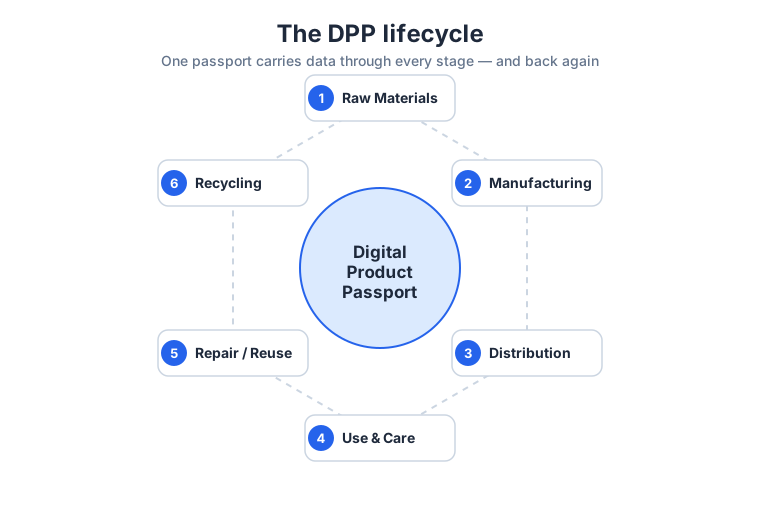
A Digital Product Passport (DPP) is a digital record that travels with a product through its lifecycle, carrying verifiable information about its identity, materials, sustainability performance, compliance status and circularity — accessible by scanning a data carrier such as a QR code on the product.
- •Legal basis: the Ecodesign for Sustainable Products Regulation (ESPR, EU 2024/1781), plus sector laws like the Battery Regulation
- •First deadline: 18 February 2027 — battery passports become mandatory
- •Standards: the EN 182xx family (identifiers, carriers, APIs, storage, interoperability) — cited in the EU Official Journal
- •Scope: nearly every physical product sold in the EU will eventually need one — including imports
What is a Digital Product Passport?
Legal definition — ESPR Article 2(28)
A 'digital product passport' is a set of data specific to a product that includes the information specified in the applicable delegated act and that is accessible via electronic means through a data carrier.
In plain terms: the DPP is a digital identity card for physical products. Just as a person's passport proves who they are and carries endorsements accumulated over a lifetime of travel, a product's DPP proves what it is — where it was made, what it contains, how it performs on sustainability metrics, and what should happen to it at end of life.
But the passport analogy understates the engineering. A DPP is not a document, a PDF, a label or a QR code. It is a distributed data system: a unique product identifier, a physical data carrier that binds the identifier to the item, structured product data hosted by the manufacturer or a service provider, a registration record in an EU-level Registry, and APIs that govern who may read and write each data element.
This distinction matters commercially. Organisations that treat the DPP as "a QR code project" will build a sticker. Organisations that treat it as a data-infrastructure project will build something that survives audits, delegated-act changes and a decade of product lifecycle events.
Where the DPP came from
The DPP did not arrive from nowhere — it is the product of a decade of EU product-policy evolution. The European Green Deal (2019) established the strategic frame: decouple growth from resource use and make sustainable products the norm. The Circular Economy Action Plan (2020) then named the instrument — a "digital product passport" — as the mechanism to carry product information through the value chain.
The concept was then battle-tested. The CIRPASS consortium (2022–2024) ran the first large cross-sector pilots — batteries, electronics, textiles — producing the initial reference architecture and proving the model worked across industries. CIRPASS-2 carried this forward into the deployable eudpp core ontology and lighthouse pilots. In parallel, the Battery Regulation (2023) became the first law to mandate a sectoral passport — proving the concept in binding law before the horizontal framework existed.
The ESPR (2024/1781) then made it horizontal: one framework law covering nearly all physical goods, with the DPP as its general information mechanism. The EN 182xx standards (cited in the OJ in 2026) turned the legal shell into an implementable system. What began as a policy idea is now a published legal-technical stack.
Why the DPP exists
The DPP is the data backbone of the EU's circular-economy agenda. It solves three concrete failures of today's product-information ecosystem:
1. The market-surveillance gap
Hundreds of millions of products enter the EU each year, and customs and market surveillance authorities cannot physically verify a meaningful fraction of them. Compliance today is largely honour-based. The DPP gives authorities a machine-readable way to check, at the border and in the market, whether a product's claimed conformity is backed by real registered data — automatically, at scale.
2. The information asymmetry problem
Consumers, repairers, recyclers and remanufacturers routinely cannot learn what a product is made of, whether it can be repaired, or how to recover its materials. Value is destroyed at end of life because the knowledge needed to preserve it never reached the actor who needed it. The DPP makes product information travel with the product.
3. The unverifiable-claims problem
Sustainability claims today live in marketing copy and static reports. Regulators (through the Green Claims agenda), buyers and auditors increasingly demand evidence. A DPP binds claims to structured, verifiable data records rather than assertions.
The legal basis: ESPR and sector legislation
The framework law is the Ecodesign for Sustainable Products Regulation (ESPR), Regulation (EU) 2024/1781, which entered into force on 18 July 2024. The ESPR does not itself impose a DPP on any product today. Instead, it establishes the DPP system and empowers the Commission to activate it product-group-by-product-group through delegated acts — product-specific legal acts that define which information each group's passport must contain.
In parallel, several sector-specific laws mandate their own passports using the same underlying system — most importantly the EU Battery Regulation (2023/1542), Article 77, which creates the battery passport, the first DPP with a hard compliance date. The Construction Products Regulation, the revised Toy Safety Regulation, the Packaging and Packaging Waste Regulation and the Detergents Regulation all follow the same pattern.
The rollout timeline (indicative, per the Commission's working plan)
| Product group | Expected DPP obligation | Legal instrument |
|---|---|---|
| Batteries (EV, industrial >2 kWh, LMT) | 18 February 2027 — first hard deadline | Battery Regulation 2023/1542, Art. 77 |
| Iron and steel | 2026 (first ESPR delegated acts) | ESPR delegated act |
| Textiles, tyres, aluminium | 2027 | ESPR delegated acts |
| Energy-related products | 2026–2029 (rolling) | ESPR delegated acts |
| Furniture | 2028 | ESPR delegated act |
| Mattresses, ICT products | 2029 | ESPR delegated acts |
Read the table correctly: these are dates by which the Commission intends to have delegated acts in place or applying. Each act typically grants a transition period (commonly ~18 months) before the obligation bites — but data plumbing, supplier onboarding and system integration take longer than that to build well. Organisations that start when the act publishes are already late.
How a Digital Product Passport actually works
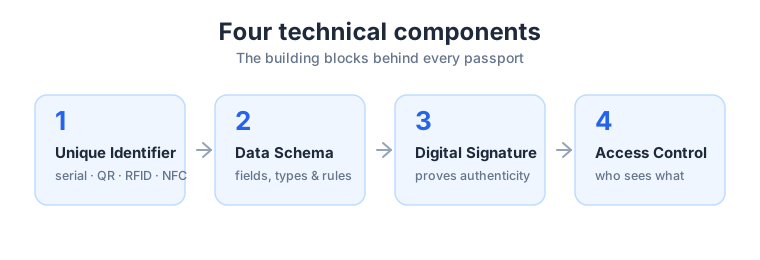
Architecturally, every DPP — regardless of product group — combines four components defined by the ESPR and elaborated by the EN 182xx standards:
1. Unique product identifier
Every DPP is anchored to identifiers defined by EN 18219: a unique product identifier (UPI) at model, batch or unit level, plus a unique operator identifier (UOI) and unique facility identifier (UFI) for the responsible actors. In practice these build on GS1 keys — GTIN plus serial number for unit-level identity.
2. Data carrier
A physical carrier — QR code, Data Matrix, NFC tag or RFID, chosen per EN 18220 — affixed to the product, packaging or accompanying documents. It encodes the identifier, typically as a GS1 Digital Link URI that resolves to the passport data.
3. Decentralised data storage
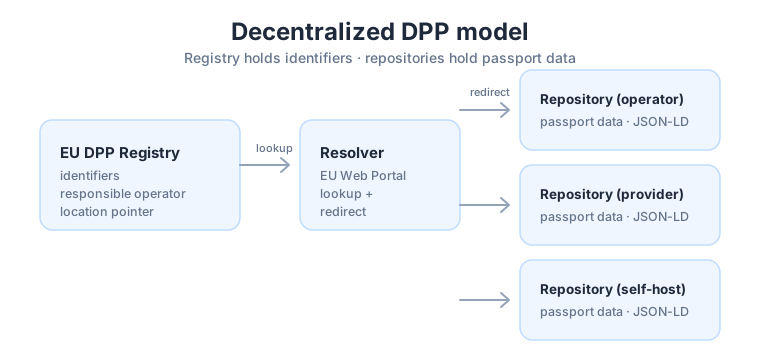
The DPP data itself is not stored in a central EU database. It is held by the economic operator or a contracted DPP service provider, per EN 18221's persistence requirements. The EU holds only the registration index — not your product data.
4. The DPP Registry
An EU-level registry stores the identifier and mandatory registration metadata for each passport, and issues a unique registration identifier (URI). Customs can automatically verify a registration for imports; market surveillance uses it to locate the authoritative record.
The lifecycle in five steps
Identify and model
The manufacturer assigns identifiers (e.g. GTIN + serial), assembles the product data required by the applicable act, and structures it against the data model.
Create and register
The DPP is created, its data hosted by the operator or service provider, and a registration record with the identifier submitted to the EU DPP Registry, which issues the URI.
Bind to the product
The data carrier encoding the identifier is affixed to the product, packaging or documents. For imports, customs can check the URI automatically at the border.
Serve and control access
Actors resolve the identifier via APIs (EN 18222). Public data is open; restricted data requires authenticated access rights per prEN 18239/18246.
Update through life
Repairs, ownership transfers, refurbished components and end-of-life events update the passport — the record persists for the required retention period.
A worked example: anatomy of a passport
Abstract architecture becomes concrete quickly. Here is what a simplified passport for a hypothetical industrial battery actually looks like — first as the machine-readable payload, then decomposed:
{
  "@context": ["https://eudpp.eu/context/core.jsonld"],
  "@id": "https://dpp.acme-battery.example/01/09501234567890/21/SN-884211",
  "@type": "eudpp:BatteryPassport",
  "identifier": {
    "gtin": "09501234567890",
    "serialNumber": "SN-884211",
    "registrationId": "dpp-reg:7f3a9c1e-..."
  },
  "manufacturer": {
    "@type": "eudpp:EconomicOperator",
    "name": "Acme Battery GmbH",
    "operatorId": "GLN 0950123450000",
    "facilityId": "UFI-PLT-DRESDEN-01"
  },
  "product": {
    "category": "industrial-battery",
    "chemistry": "NMC",
    "ratedCapacityKwh": 45.2,
    "carbonFootprint": { "value": 62.4, "unit": "kgCO2e/kWh", "class": "B" },
    "recycledContent": { "cobalt": 0.12, "lithium": 0.04, "nickel": 0.08 }
  },
  "circularity": {
    "dismantlingInfo": "restricted",
    "endOfLifeInstructions": "..."
  }
}
The @id is the resolution key
@id is the GS1 Digital Link URI — GTIN + serial. Scanning the QR on the battery resolves to exactly this record. It is the same identifier the Registry indexes and customs checks.
Context makes it interoperable
The @context ties every field to the shared eudpp vocabulary — so carbonFootprint means the same thing to a German regulator and a Korean recycler.
Access control is in the data model
Fields like dismantlingInfo: "restricted" signal which slice is public versus restricted — the same record serves the consumer view and the recycler view differently.
It is a living record
This unit's passport will be updated — state of health for EV/industrial batteries, repairs, repurposing, end-of-life — through EN 18222 lifecycle APIs, not a static file.
The EN 182xx standards: the technical rulebook
The ESPR defines that a DPP must exist; the EN 182xx standards family, developed by CEN-CENELEC Joint Technical Committee 24, defines how it works. In 2026 the first six were cited in the Official Journal through Implementing Decision (EU) 2026/1736 — meaning systems built to them enjoy a presumption of conformity with the corresponding ESPR requirements.
| Standard | Scope | Status |
|---|---|---|
| EN 18216:2026 | Data exchange protocols — how systems transport DPP data | Cited in OJ |
| EN 18219:2026 | Unique identifiers — UPI, UOI, UFI and resolution | Cited in OJ |
| EN 18220:2026 | Data carriers — QR, Data Matrix, NFC, RFID selection | Cited in OJ |
| EN 18221:2026 | Data storage, archiving and persistence | Cited in OJ |
| EN 18222:2026 | APIs for lifecycle management and searchability | Cited in OJ |
| EN 18223:2026 | System interoperability across providers and borders | Cited in OJ |
| prEN 18239 | Access rights, security and confidentiality | In finalisation |
| prEN 18246 | Authentication, reliability and integrity | In finalisation |
Beneath the standards sit the data models: the CIRPASS-2 eudpp ontologyprovides the reference semantic model, expressed in JSON-LD for exchange and validated with JSON Schema and SHACL. Identifier and carrier practice builds on GS1 (GTIN, GLN, Digital Link). At the international layer, ISO/TC 154 is developing ISO 25534 to align DPP concepts globally.
What data goes inside a DPP
The precise dataset is defined per product group in each delegated act, anchored to the ecodesign parameters in ESPR Annex III. Across acts, six categories recur:
Identity & origin
Product identifiers, model/batch/serial, manufacturer and facility identifiers, country of manufacture.
Materials & substances
Material composition, recycled content, substances of concern and their location in the product.
Sustainability performance
Carbon footprint, durability, repairability scores, energy and resource efficiency — the metrics the delegated act mandates.
Compliance evidence
Declarations of conformity, test reports, certificates and references to notified-body assessments.
Circularity information
Repair instructions, spare-part availability, disassembly guidance, recycling and end-of-life handling.
Actors & events
Supply-chain actors and lifecycle events — ownership transfers, repairs, refurbishment — written to the passport over time.
Who must comply — and who is exposed
DPP obligations attach to products "placed on the market" in the EU — the first making available of a product, whether manufactured in the Union or imported. The ESPR distributes responsibility across the value chain:
| Actor | Core DPP obligation |
|---|---|
| Manufacturer (EU or non-EU) | Create the DPP, populate required data, register it, issue the data carrier, keep data available for the retention period |
| Importer | For third-country products, ensure the DPP exists and is registered before placing on the market — effectively assumes the manufacturer role for imports |
| Distributor / dealer | Verify a data carrier is present before making the product available; act with due care |
| Online marketplaces & fulfilment providers | Cooperate with market surveillance; enable checks; covered explicitly by the ESPR's distance-sales provisions |
| DPP service providers | Host passport data on behalf of operators under EN 18221 persistence and backup requirements |
The critical point for non-EU businesses: a product group covered by a delegated act cannot legally enter the EU market without its passport. "We're not a European company" is not an exemption — it is precisely the scenario the customs-integration is built for.
Who sees what: the access-tier model
A DPP is not one document everyone reads the same way — it is a layered record with different audiences seeing different slices. Access control is built into the architecture (governed by prEN 18239/18246), because the same passport must satisfy a curious consumer and a market-surveillance inspector without exposing commercially sensitive data to the former:
| Audience | Typical access | What they see |
|---|---|---|
| Consumer / public | Unrestricted scan | Identity, sustainability score, recycled content summary, repair info, recyclability |
| Dealer / distributor | Basic verification | Conformity status, data-carrier validity — enough to confirm the passport exists |
| Recycler / refurbisher | Restricted — role-gated | Material composition, disassembly instructions, substance-of-concentration flags |
| Market surveillance / customs | Authoritative — full | Complete record, compliance evidence, registration status, audit trail |
| Notified body / auditor | Assessment scope | Technical documentation, test evidence, conformity-assessment records |
This tiering is why "the passport" is better understood as one record, many views. The consumer-facing QR resolves to the public slice; the same underlying data exposes richer fields to authenticated roles. Getting this access model right — what is public, what is restricted, and to whom — is one of the harder design problems in a real implementation.
Key terms worth knowing
| Term | Meaning |
|---|---|
| Unique product identifier (UPI) | The string that identifies the individual product instance the passport belongs to |
| Data carrier | The physical tag (QR, Data Matrix, NFC) that carries the identifier and links to the passport |
| Economic operator | Manufacturer, importer, distributor, dealer, or fulfilment provider with a defined DPP duty |
| DPP Registry | The EU-run index storing identifiers and registration metadata — not the data itself |
| Delegated act | A product-group-specific legal act that activates DPP duties and defines required data |
| Presumption of conformity | The legal benefit of following a cited harmonised standard — conformity is assumed |
| Data space | The decentralised hosting model where each operator holds its own passport data |
| GTIN | GS1 Global Trade Item Number — the identifier most DPPs will build on |
Data carriers: how the physical meets the digital
EN 18220 governs how the identifier is physically bound to the product. There is no single mandated carrier — the right choice depends on the product's environment, price point and lifecycle:
| Carrier | Strengths | Best fit |
|---|---|---|
| QR code | Zero-cost, universally scannable by phones | Consumer goods, packaging, documents |
| Data Matrix | Compact, robust to damage and abrasion, industrial-printable | Batteries, small parts, harsh environments |
| NFC tag | Tap-to-read, harder to counterfeit, read without line of sight | Higher-value goods, textiles, luxury |
| RFID | Bulk scanning, no line of sight, warehouse-grade | Logistics, inventory, high-throughput operations |
DPP vs EPD, PCF, CE marking and traceability
The DPP is constantly confused with adjacent instruments. The distinctions matter for scoping your compliance work:
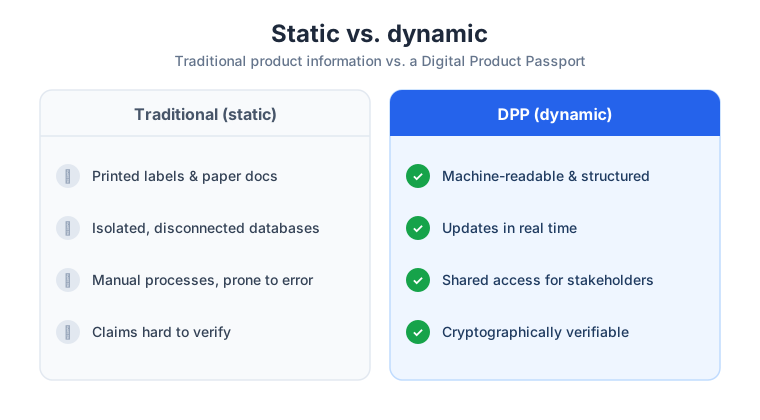
| Instrument | What it is | Static or dynamic | Mandatory? |
|---|---|---|---|
| Digital Product Passport | A living data system carrying identity, materials, sustainability, compliance and lifecycle events | Dynamic — updated through life | Yes, progressively per product group |
| EPD (Environmental Product Declaration) | A standardised LCA-based document reporting environmental impact | Static document | Mostly voluntary / procurement-driven |
| PCF (Product Carbon Footprint) | A single-metric calculation of lifecycle GHG emissions | Static metric (one data point) | Context-dependent (e.g. batteries) |
| CE marking / DoC | A conformity mark and declaration that requirements are met | Static claim | Yes where harmonised law applies |
| Traceability system | Internal tracking of a product through the supply chain | Dynamic but private | Only in specific sectors |
The practical relationship: an EPD or PCF is content a DPP may carry; CE marking is a claim the DPP substantiates with evidence; a traceability system is infrastructure you may already have that the DPP must interoperate with.
Six misconceptions to retire early
"The DPP is a QR code."
The QR code is the carrier. The passport is the data system behind it — identifiers, hosted data, registry record, APIs and access control.
"All our product data becomes public."
No — the ESPR defines tiered access. Public data is a defined subset; commercially sensitive data is restricted by role. Access control is a designed feature, not an afterthought.
"The EU stores all our data."
No — storage is decentralised. The Registry holds identifiers and registration metadata; the data itself stays with you or your service provider.
"It only applies to EU manufacturers."
It applies to products placed on the EU market — including everything imported. Importers carry the obligation for third-country goods.
"We can wait for our product group's delegated act."
You can, but you will be behind. Identifier strategy, data quality remediation and supplier onboarding take longer than typical transition periods.
"It's a compliance cost with no upside."
The same infrastructure enables repair services, resale, warranty automation, supply-chain intelligence and verified sustainability claims — commercial returns beyond compliance.
How to prepare: five steps
Determine applicability
Map your product portfolio against the delegated-act pipeline. Which groups are you in? When do obligations bite? Use a structured assessment rather than intuition.
Fix your identifier strategy
Decide your granularity (model / batch / unit), align on GS1 keys, and resolve how identifiers will be issued, governed and resolved across your products.
Audit your data
Most organisations discover the required data exists but is scattered, unstructured or unverifiable across ERP, PLM, supplier documents and spreadsheets. Inventory it against Annex III-style requirements.
Pilot one product line
Build a real passport for one SKUs-worth of products: identifier, carrier, data model, hosting, API access. Learn on a bounded scope before scaling.
Build internal capability
DPP implementation spans legal, sustainability, IT and supply chain. Teams that understand the standards and architecture deliver materially better outcomes than teams learning under deadline pressure.
Frequently asked questions
Learn the foundations
The Certified Digital Product Passport Foundations (CDPF) course covers everything in this guide in structured depth — ESPR, the data model, APIs and circular-economy applications. ~4-5 hours, first two chapters free.
Explore CDPFBuild real DPP systems
The Certified Digital Product Passport Implementer (CDPI) certification is for the people who will actually implement this: EN 182xx standards, eudpp data model, identifiers, carriers, security and deployment — with hands-on labs.
Explore CDPIFurther reading: start with the free preview chapter What is a Digital Product Passport?, the implementer chapter on the EN 182xx standards family, or the open UPPS product passport framework.