The EN 182xx Standards Explained: The EU DPP Technical Rulebook
The ESPR says a passport must exist; the EN 182xx standards say how it works. Eight standards, what each one actually specifies, and why their citation in the Official Journal matters enormously for your build.
In 30 seconds
- •Who: written by CEN-CENELEC JTC 24 for the DPP system
- •What: identifiers, carriers, exchange, storage, APIs, interoperability, security
- •Status: 6 cited in the OJ (2026/1736) → presumption of conformity; 2 in finalisation
- •Why it matters: building to them is the lowest-risk technical route to compliance
Why these standards matter more than the regulation text
The ESPR tells you that covered products need a DPP and roughly what it is. It does not tell you how to structure identifiers, which carrier to put on the product, how data moves between your systems and the value chain, or who can see what. That is the engineering problem — and it is exactly what the EN 182xx family solves.
CEN-CENELEC Joint Technical Committee 24 wrote these standards specifically for the DPP, under a Commission mandate. They turn the ESPR's legal skeleton into an implementable technical system — the difference between reading a law and building a compliant product.
The standards family at a glance
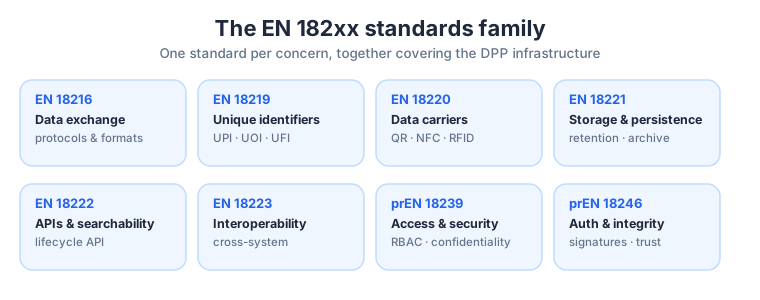
| Standard | Title | OJ status |
|---|---|---|
| EN 18216:2026 | Data exchange protocols | Cited |
| EN 18219:2026 | Unique identifiers | Cited |
| EN 18220:2026 | Data carriers | Cited |
| EN 18221:2026 | Data storage, archiving and persistence | Cited |
| EN 18222:2026 | APIs for lifecycle management and searchability | Cited |
| EN 18223:2026 | System interoperability | Cited |
| prEN 18239 | Access rights, security and confidentiality | In finalisation |
| prEN 18246 | Authentication, reliability and integrity | In finalisation |
Mapping each standard to the ESPR articles it implements
The standards are not abstract — each one operationalises a specific set of legal requirements. Reading them against the ESPR articles shows exactly what each is for:
| Standard | ESPR provision it serves | In plain terms |
|---|---|---|
| EN 18216 | Art. 9–10 (data exchange) | How passport data is formatted and moved between systems |
| EN 18219 | Art. 11 (unique identifiers) | How products, operators and facilities are identified |
| EN 18220 | Art. 11 (data carriers) | QR, Data Matrix, NFC — the physical tag rules |
| EN 18221 | Art. 12 (storage/persistence) | How passports are stored and kept available for the retention period |
| EN 18222 | Art. 9 (lifecycle/search) | The APIs to create, read, update and find passports |
| EN 18223 | Art. 9 (interoperability) | How systems across vendors interoperate on the same passport data |
| prEN 18239 | Art. 9 (access rights) | Who can see which slice of the record — the access tiers |
| prEN 18246 | Art. 10 (integrity/authenticity) | Proving a passport is genuine and untampered |
What each standard actually specifies
EN 18216 — Data exchange protocols
How DPP data moves between systems: the transport and protocol layer so that a passport created by one system can be consumed by another — the plumbing that makes cross-company exchange possible at all.
EN 18219 — Unique identifiers
The identifier system: the unique product identifier (UPI) at model, batch or unit level, the unique operator identifier (UOI) and the unique facility identifier (UFI) — their structure, assignment, and how they resolve to data. In practice built on GS1 keys.
EN 18220 — Data carriers
The physical binding: QR, Data Matrix, NFC and RFID carriers — selection criteria, robustness, application and quality requirements so the identifier survives the product's actual environment and lifetime.
EN 18221 — Storage, archiving and persistence
The obligation to keep passport data available and intact for its required life — including who may host it (economic operators and DPP service providers), backup, migration and long-term preservation requirements.
EN 18222 — APIs for lifecycle management and searchability
The operations layer: APIs to create, update, transfer and revoke passports across the lifecycle, and the search/discovery interface that lets authorised actors find and retrieve them.
EN 18223 — System interoperability
Cross-system compatibility: how DPP systems from different providers, in different Member States and value chains, interoperate — the standard that prevents passport lock-in to a single vendor's stack.
prEN 18239 — Access rights, security, confidentiality
The tiered-access model: who may read or write which data elements — the standard that keeps commercially sensitive passport data protected while public data stays open.
prEN 18246 — Authentication, reliability, integrity
Trust: how passport data is authenticated and protected against tampering — the integrity layer that makes a passport something authorities can rely on rather than merely read.
Presumption of conformity — the mechanism that makes these matter
Presumption of conformity
Under the EU's New Legislative Framework, when a harmonised standard is cited in the Official Journal, a product or system built to that standard is presumed to conform with the corresponding legal requirements.
This is why the citation of EN 18216–18223 in Implementing Decision (EU) 2026/1736 is a bigger deal than it looks. Until standards are cited, "compliance" is your own interpretation of the law. Once cited, building to the standard is the default safe harbour: you are presumed to meet the covered requirements unless proven otherwise.
The alternatives are all worse: interpret the regulation yourself and carry the equivalence argument; wait for market practice to settle; or hire counsel to certify a bespoke approach. For most organisations, tracking the cited standards is simply the lowest-risk engineering posture available.
How an EN standard is born — and why citation matters
The EN 182xx standards followed the European standardisation pipeline. The European Commission issued a standardisation request to CEN-CENELEC asking for standards to support the ESPR's DPP provisions. JTC 24 — the joint technical committee created for product passports — then drafted each standard through national-member consensus.
The lifecycle of each document moved through distinct stages:
- Working draft → prEN — a "proposed European Standard" open for public enquiry. prEN 18239 and 18246 are currently at this stage — published for comment, not yet final.
- Formal vote → EN — national standardisation bodies vote; on approval the prEN becomes an EN and is published identically by every member body (BS EN, DIN EN, NF EN…).
- OJ citation — the decisive step. When the Commission cites the standard in the Official Journal (as Implementing Decision (EU) 2026/1736 did for the six EN 182xx), the standard becomes a harmonised standard — and conformity with it confers the legal presumption of conformity.
This is why the citation event matters more than the publication event. A standard can exist for months before it is cited — only citation activates its legal effect under the ESPR.
How they relate to GS1, eudpp and ISO
The EN 182xx family does not reinvent everything — it orchestrates existing building blocks. Identifiers and carriers build on GS1: GTIN, GLN, GS1 Digital Link, QR/Data Matrix symbologies. The data model draws on the CIRPASS-2 eudpp reference ontology, exchanged as JSON-LD and validated with JSON Schema and SHACL. And at the international layer, ISO/TC 154's ISO 25534 is in development to align DPP concepts globally — so the EU system can interwork with future regimes elsewhere.
How to read a harmonised standard efficiently
A practical sequence for engineers: (1) read the scope and normative references first — they define exactly what is covered; (2) map the normative requirements ("shall" clauses) to your system components; (3) treat informative annexes as guidance, not obligation; (4) track which standard covers which legal requirement — the presumption attaches to specific mappings, not blanket compliance.
For the DPP specifically: start with EN 18219 (identifiers) and EN 18220 (carriers) — they anchor everything else — then move to the data-plane standards (18216/18222) and finally the trust and access layer (18239/18246 when finalised).
Frequently asked questions
Implement to the standard, not around it
The CDPI Implementer certification is built around these standards — identifiers, carriers, data model, APIs, access control — with interactive labs on identifier resolution and the data model.
Explore CDPIRelated: GS1 Digital Link · the DPP timeline