DPP Readiness Checklist: 10 Steps to Digital Product Passport Compliance
A working programme, not a whitepaper. Ten steps, in the order they actually block each other — from scoping to pilot to governance.
In 30 seconds
- •Start now if you are in batteries, iron/steel, textiles, tyres or aluminium
- •Long pole: data assembly + supplier data agreements, not software
- •Smart posture: own the data and identifiers, buy the infrastructure
- •Prove it on one line before scaling to the portfolio
How to use this checklist
Work it in order. Each step is a gate for the next — identifier decisions before data modelling, data inventory before supplier agreements, a working pilot before industrialisation. The steps that look administrative (scoping, governance) are the ones that determine whether the technical build is pointed at the right target.
The 10-step checklist
Map your product portfolio against the delegated-act pipeline
List every product line you place on the EU market. Map each against the working-plan sequence (iron/steel, textiles, tyres, aluminium, furniture, ICT, batteries via the sector route). Output: an applicability matrix with an expected obligation date per line.
Decide your identifier granularity and system
Model-level, batch-level or unit-level passports? Align on GS1 keys (GTIN, GLN) and how serialisation will work if unit-level is required or chosen. Identifier decisions are irreversible-ish — get them right early.
Inventory the data you have against the data you need
For each covered product line, list required data attributes (Annex III-style) and locate where each lives today: ERP, PLM, LCA studies, supplier docs, test reports, spreadsheets — or nowhere. Output: a data gap register.
Remediate data quality
The passport must carry accurate, structured, verifiable data. Fix the gaps: commission missing studies, digitise paper documentation, normalise units and formats, and build validation rules. This is where programmes live or die.
Contract for supplier data
Carbon footprint, recycled content, material composition and due-diligence data largely sit with upstream suppliers. Add data-provision clauses to supply agreements now — renegotiating under deadline is brutal.
Choose build vs service provider
Decide who hosts and operates the passport data. A DPP service provider handles persistence, access control and APIs as a service; building in-house means owning EN 18221 persistence obligations yourself.
Design the data architecture
Canonical data model mapped to the applicable act's attributes, JSON-LD/structured payloads, validation (JSON Schema/SHACL), and the integration paths from ERP/PLM into the passport layer.
Implement access control
Model the tiered access the delegated act requires — public data vs restricted data for authorities, recyclers, partners. Map it to roles before you build, not after.
Pilot one product line end-to-end
A real passport for a bounded set of SKUs: identifier → carrier → hosted data → registry record → resolved scan, including restricted access. Fix what breaks before scaling.
Stand up governance and operations
Who owns passport accuracy? Who approves updates? Lifecycle events (repairs, transfers, EoL) need writers. Registry monitoring, delegated-act change tracking, and audit-readiness are permanent functions — staff them.
The readiness maturity model
Score yourself honestly — most organisations overestimate. The level that matters is the weakest of the three dimensions, because a single gap blocks compliance:
| Level | Legal awareness | Data readiness | Technical capability |
|---|---|---|---|
| 0 — Unaware | No one owns DPP | Data scattered, unmapped | No identifier scheme |
| 1 — Assessing | Scoping which acts apply | Gap analysis underway | Evaluating options |
| 2 — Building | Obligations mapped per product | Pipelines + supplier contracts | Pilot passport running |
| 3 — Piloting | Conformity process defined | Quality + validation live | Registry-linked pilot |
| 4 — Operational | Ongoing compliance owner | Governed data lifecycle | Passports issued at scale |
The pattern we see most: organisations at Level 2 technical, Level 1 data. They can build a passport API but cannot populate it — because the data dimension lags. Treat data readiness, not technology, as your binding constraint and plan backwards from it.
The gaps everyone finds
Data exists but isn't provable
Recycled-content and carbon claims live in marketing decks or unaudited spreadsheets. The passport expects verifiable data — provenance and evidence matter as much as the number.
Suppliers can't (or won't) provide structured data
Most upstream suppliers deliver PDFs and emails, not machine-readable data. This is a commercial and contractual problem, not a technical one — and it has the longest lead time in the whole programme.
Nobody owns the passport internally
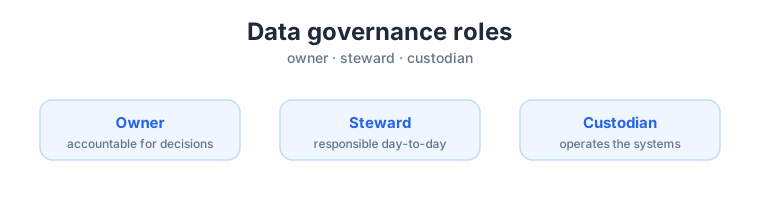
DPP touches legal, sustainability, IT, product and supply chain. Programmes stall when ownership is ambiguous — assign an accountable owner early, with the authority to pull data across functions.
Failure modes — and how to head them off
These are the specific ways DPP programmes actually stall, paired with the mitigation that works:
| Failure mode | Why it happens | Mitigation |
|---|---|---|
| Waiting for the delegated act | Teams treat the data model as unknowable until the act lands | Build to the EN 182xx + eudpp core now — delegated acts specify product data, not the plumbing |
| Supplier data never materialises | Data requested informally; no contract lever to compel it | Add DPP data clauses to new supplier contracts and renewals — treat it as a procurement term |
| A pilot that can't scale | Passport hand-built for one product, no repeatable pipeline | Pilot on one SKU but engineer the data pipeline for the whole portfolio from day one |
| Compliance built, lifecycle ignored | Focus on issuing the passport, not on updates (repairs, repurposing) | Design EN 18222 lifecycle APIs and an update workflow — a passport is a living record |
| Identifier chaos | No governed GTIN/serial scheme; identifiers minted ad hoc | Assign identifiers under a governed scheme (EN 18219) before any technical build |
Build vs buy
| Approach | Pros | Cons | Best for |
|---|---|---|---|
| DPP service provider | Fast, compliant persistence/access control out of the box; liability structure clear | Recurring cost, dependency, less control | Most mid-market manufacturers and importers |
| In-house build | Full control; integrates deeply with ERP/PLM; data strategy asset | You own EN 18221 persistence, security and ops — real engineering commitment | Large organisations where passport data is strategic |
| Hybrid | Own the data model + identifiers; rent hosting/access layer | Needs clean interface contracts | Most enterprises — the pragmatic default |
A realistic timeline
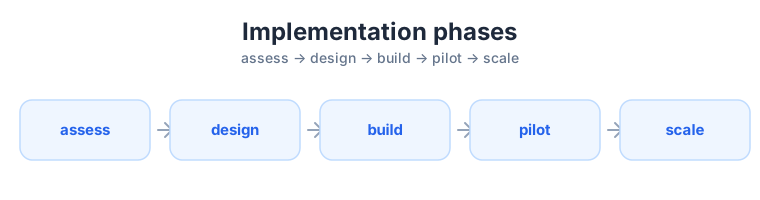
For a mid-sized manufacturer with a modest portfolio: 6–9 months to a conforming pilot, 12–24 months to portfolio-scale operation — dominated by data remediation and supplier agreements, not software. Compress it by running steps 3–5 (data, suppliers) in parallel with 6–8 (platform, architecture), never in series.
The deadline logic from the rollout timeline applies directly: subtract your realistic programme duration from the obligation date — that is your real start-by date, and for early product groups it has already passed for slow movers.
Frequently asked questions
Build the capability in-house
The CDPI Implementer certification trains your team on exactly this — identifiers, data model, carriers, access control, APIs and deployment, with hands-on labs.
Explore CDPIRelated: the complete DPP guide · who is obligated