The Evolution of Product Traceability
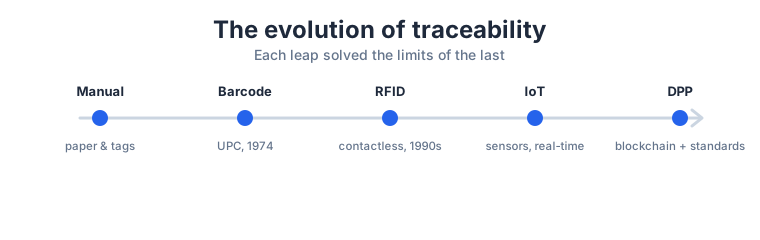
Key insight: Product traceability evolved from paper ledgers to machine-readable digital passports in a series of distinct leaps — each one solving the limits of the last, and together enabling the DPP.
1. The pre-digital era
Before digital systems, traceability was entirely manual. Four mechanisms carried the load:
- Paper ledgers — handwritten records of production batches, shipments, and transactions, prone to error and illegibility.
- Physical tags — labels, stamps, and embossed markings that offered identification but nothing more.
- File cabinets — physical filing systems, slow to search and vulnerable to fire or loss.
- Manual verification — in-person inspection by human inspectors, subjective and unscalable.
These systems had hard limits: high error rates, slow processes (days or weeks to trace a product's history), vulnerability to loss, no real-time updates, geographic constraints, and poor scalability.
The consequences were concrete and sometimes tragic. During a food-contamination outbreak, tracing a contaminated ingredient back to its source could take weeks — and each day of delay meant more exposure and a wider, costlier recall. Manual traceability could tell you a product existed; it often couldn't tell you where it had been, right now.
What was the fundamental limitation of pre-digital traceability?
2. Barcodes and the digital revolution
The barcode was the first machine-readable leap. The Universal Product Code (UPC), introduced in 1974 (famously, the first item scanned was a pack of chewing gum), gave each product a unique machine-readable identifier. This enabled automated capture at the point of sale, real-time inventory tracking, and basic supply-chain visibility.
But barcodes remained limited: static information, one-way communication, small capacity, a need for a central database, line-of-sight scanning, and vulnerability to physical damage.
RFID (Radio Frequency Identification) removed several of those limits in the 1990s:
- Contactless reading — radio waves penetrate packaging, so items can be scanned without a direct line of sight.
- Batch processing — hundreds of tags read simultaneously.
- Rewritable data — tags can be updated as products move.
- Enhanced security — encryption and authentication resist counterfeiting.
RFID's business case was proven early: large retailers mandated RFID tags on pallets and cases because inventory accuracy and out-of-stock rates improved dramatically. That adoption built the infrastructure later systems would use.
IoT then added sensing: temperature, humidity, shock, location, and more, monitored continuously. This shifted traceability from periodic scans to a real-time stream, enabling predictive analytics and "smart" products that report their own condition — a cold-chain shipment, for example, could now alert the sender the moment its temperature exceeded safe limits, rather than after the goods spoiled.
Which technology first enabled *continuous* condition monitoring of products in transit?
3. The blockchain era
Blockchain introduced a new property: trust without a central authority, which matters in multi-company supply chains where parties don't fully trust each other.
- Immutable records — data can't be altered once written.
- Decentralized verification — no single point of control or failure.
- Cryptographic security — each transaction is signed; the ledger is tamper-evident.
- Transparent audit trails — every participant can see the full, cryptographically-provable history.
Smart contracts — self-executing rules encoded in software — build on this to automate compliance (verifying certifications), conditional payments (releasing funds on verified milestones), dynamic updates, multi-party agreements, and real-time auditing.
The value is easiest to see in a high-stakes context. If a luxury good's authenticity can be verified by scanning a QR code that queries an immutable ledger, counterfeiting becomes far harder. If a payment is automatically released when a shipment is verified delivered, disputes and settlement time collapse.
Blockchain is not a panacea — it carries implementation cost, technical complexity, energy use (for proof-of-work), and a need for industry-wide adoption to deliver network benefits. That's why many implementations use hybrid approaches: blockchain for tamper-evidence where trust is weakest, conventional databases for everything else.
What does blockchain's *immutability* guarantee?
4. The machine-readability revolution
Collecting data is only useful if machines can process it. This era focused on standardizing formats so systems can exchange and interpret data automatically:
- JSON Schema — a framework for validating and documenting JSON structures.
- XML standards — the earlier dominant format, still used in legacy and regulatory contexts.
- API specifications — REST and GraphQL standardize how systems request and exchange data.
- Semantic web — ontologies and knowledge graphs that let machines understand relationships, not just values.
Interoperability frameworks — led by GS1 (which gave us GTIN, GLN, and EPCIS) and ISO — provide the common vocabulary that lets different organizations' systems communicate.
Machine-readability is what enables automated processing, global scale, consistency, integration, and real-time response — the foundation on which DPPs are built. Without it, "digital" traceability is just faster paper.
Which organization's standards (GTIN, EPCIS) form the backbone of modern supply-chain traceability?
5. From traceability to intelligence
Traceability matured through three phases, each answering a deeper question:
| Phase | Question it answers |
|---|---|
| Tracking | Where is the product, and who handled it? |
| Transparency | What is it made of, and where did it come from? |
| Intelligence | What will happen, and what should we do? |
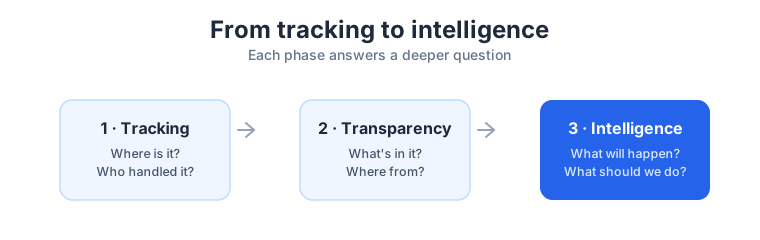
The shift to intelligence — enabled by DPPs — turns traceability from a retrospective record into a forward-looking decision system. Consider a shipment whose temperature sensor records a spike. A tracking system notes the event. A transparency system makes it visible. An intelligent system predicts the shelf life has shortened, recommends expedited routing, and updates inventory automatically — all without human intervention.
A system predicts a shipment's shelf life has dropped and automatically reroutes it. Which phase is this?
6. Case study: one battery, every era
To see the whole evolution in one object, trace a lithium-ion battery through each era's tools.
- Pre-digital: the battery's origin and composition exist only in a paper ledger at the factory. A recycler years later cannot know what's inside without destructive testing.
- Barcode: the battery carries a barcode identifying its model — but nothing about its individual history, condition, or materials.
- RFID/IoT: the battery is tagged and its temperature, charge cycles, and location are logged continuously as it moves through the supply chain.
- Blockchain: its journey is recorded immutably, so a buyer can verify the battery's claimed provenance and a recycler can trust its history.
- DPP: all of this converges into a single machine-readable record — identity, composition, provenance, condition history, and end-of-life instructions — accessible to the right stakeholder at the right time.
That single object's journey is the story of the whole field: each era solved a limitation, and the DPP is the point where they all come together.
7. The future & key points
The next leap combines AI/ML (pattern recognition, predictive analytics, NLP, computer vision, anomaly detection) with digital twins (virtual replicas for simulation and predictive maintenance), and emerging technologies such as quantum computing, augmented reality, and 6G networks. These deepen intelligence rather than replacing the fundamentals.
Key points
- Traceability evolved from manual records to barcodes, RFID, IoT, and blockchain.
- Blockchain added trust — immutability, decentralized verification, and smart contracts.
- Machine-readable standards (JSON, GS1) made automated, cross-system exchange possible.
- DPPs complete the journey from tracking → transparency → intelligence.
- AI and digital twins are the next leap, built on the DPP foundation.
Key takeaway: The DPP is not a sudden invention — it is the culmination of decades of traceability evolution, and the foundation for the next phase: intelligence.
Module Quiz
Introduction to Product Passports Quiz
8 questions • 10 min