What is a Digital Product Passport?
Key insight: A Digital Product Passport (DPP) is a digital twin of a physical product — a machine-readable record that travels with the product through its entire lifecycle, accumulating and updating information as it goes.
1. What a DPP is
A DPP is a machine-readable digital record containing standardized, comprehensive information about a product. Unlike a static label or paper document, it is dynamic: it can be updated as the product is repaired, resold, or recycled, and it can be read and verified automatically by software.
The phrase "digital twin" is deliberate. Where a printed label is a snapshot frozen at manufacturing time, a DPP is a living record that mirrors the product's changing state — its ownership, its condition, its compliance status — over years.
To see why this matters, follow a single battery through its life. At the factory, its DPP is created with a unique identifier, chemistry, and production date. When it ships, a logistics event is appended with location and handling data. If it's installed in a vehicle, that ownership change is recorded. Years later, when it fails, a repair technician reads the repair instructions; when it's finally recycled, the recycler reads the exact material composition. One record, many actors, continuously updated — that is what a label cannot do.
Five characteristics set a DPP apart from traditional product information:
| Characteristic | What it means |
|---|---|
| Lifecycle coverage | Tracks a product from design through end-of-life |
| Machine-readable | Structured data that software can process and verify |
| Dynamic & updateable | Information changes as the product's status changes |
| Secure & verifiable | Cryptographic signatures prove authenticity |
| Access-controlled | Each stakeholder sees only what they are permitted to see |
A DPP organizes information into seven categories, often called the information hierarchy:
- Identity & specifications — identifiers, model numbers, and technical specs.
- Material composition — substances, percentages, and certifications.
- Origin & provenance — where materials were sourced and the product made.
- Environmental impact — carbon, water, and energy footprint across the lifecycle.
- Compliance & certification — standards met and certifications held.
- Usage & maintenance — repairs, maintenance, and modifications.
- End-of-life — recycling, repair, and disposal guidance.
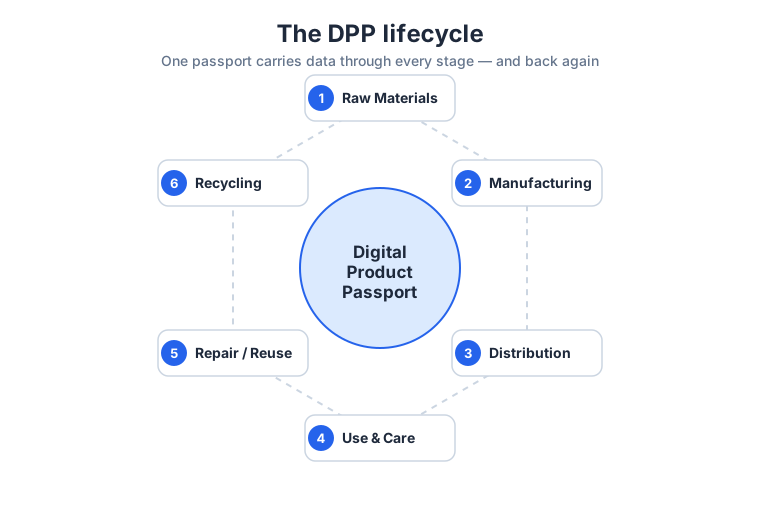
A repair record can be added to a product's passport months after it was first created. Which characteristic makes this possible?
2. From static labels to dynamic passports
Traditional product information is static and disconnected, managed through five familiar mechanisms:
- Physical labels and documentation — printed once, then lost or discarded.
- Proprietary databases — isolated per company, with no integration between them.
- Manual processes — paper forms, emails, and phone calls between parties.
- Limited accessibility — information is hard to reach when it's needed.
- Static nature — once recorded, data rarely changes even when the product does.
These limitations produce real, costly consequences:
| Limitation | Consequence |
|---|---|
| Information silos | A recycler can't access material-composition data |
| Static nature | Safety recalls aren't reflected in documentation |
| Manual processes | Paper forms and emails introduce errors and delays |
| Limited verification | Sustainability claims are hard to check, enabling greenwashing |
| No interoperability | Different data formats prevent integration |
Consider a safety recall. In a static system, the manufacturer knows the affected batch, but not which specific units reached which customers — so the recall is broad, slow, and expensive. In a DPP system, each unit's passport records its serial number, batch, and distribution path, so the recall can target only the affected units. That single difference can save lives and millions in cost.
A DPP removes these limits through a set of innovations: machine-readability, real-time updates, universal access for authorized stakeholders, standardized formats, blockchain integration (optional but common), and automated verification.
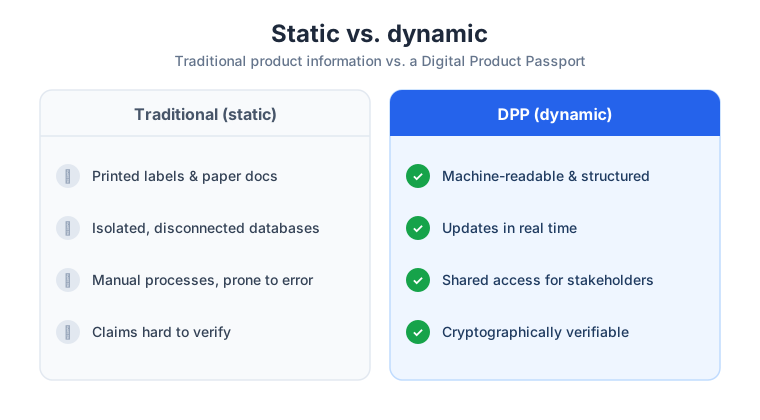
A consumer can't verify a sustainability claim by reading a paper label. Which two DPP capabilities fix this?
3. Four technical components
A DPP system rests on four technical components. Each solves a specific problem, and removing any one breaks the whole.
Unique product identifier
Every passport needs a globally unique identifier — the primary key linking all its data. Without it, two companies' records of "battery model X" would collide, and cross-organization references would break.
- Serial numbers — traditional alphanumeric identifiers.
- QR codes — two-dimensional barcodes linking to an online passport.
- RFID tags — radio-frequency identification for automated scanning.
- NFC chips — near-field communication for smartphone interaction.
The identifier must be persistent — it never changes, even if the product is resold, repaired, or refurbished.
Structured data schema
Passport data is organized by a standardized schema that defines fields, formats, required values, validation rules, and relationships. The schema is what makes data interoperable: if every implementation agrees that percentage is a number from 0 to 100, then software anywhere can validate it. This is why the DPP technical system (the JTC 24 standards) exists.
Digital signature & verification
Passports are cryptographically signed by their issuer. Anyone with the issuer's public key can verify that the data is authentic and unchanged. Changes are recorded in a tamper-evident manner, creating an audit trail of who changed what, when. This is what makes a claim trustworthy, not just present.
Access control
Not all product information is public. Access control determines who can read and write which fields, via authentication (who is requesting), authorization (what they may access), and audit logging (recording all access):
| Stakeholder | Access level |
|---|---|
| Manufacturer | Full access |
| Consumer | Limited (safety, sustainability, usage) |
| Regulator | Compliance data |
| Recycler | Material composition & disposal |
| Repair technician | Service & maintenance records |
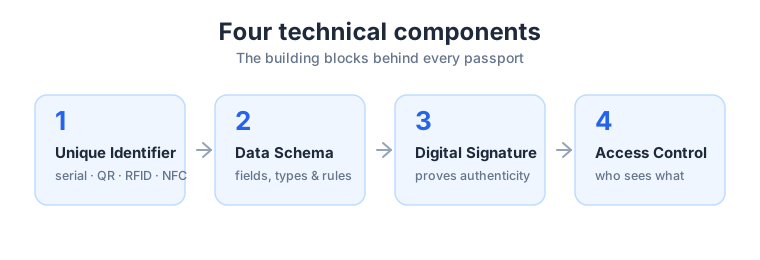
Which component prevents a recycler from reading a manufacturer's confidential supplier list?
4. Why it matters for sustainability
DPPs are not just better information management — they are foundational to the circular economy and to credible sustainability claims.
Enabling the circular economy — recyclers need material data to recover materials; repair technicians need construction and maintenance data; resellers need condition history. DPPs supply all three in machine-readable form, supporting recycling, repair, refurbishment, and product-as-a-service models. Without this information, circular strategies stall at the first data gap.
Enhancing transparency — verifiable, standardized data prevents greenwashing. A brand claiming "100% recycled" can be checked against the passport's actual recycled-content field, automatically.
Driving accountability — complete audit trails let organizations verify suppliers, and let regulators enforce compliance and due-diligence rules. Accountability without data is just reputation.
True or false: a DPP's main sustainability value is that it makes product information *available*, not that it makes it *verifiable*.
5. Interoperability across four dimensions
For DPPs to work globally, they must be interoperable across four dimensions:
- Geographic — a passport created in one country must be readable in another, requiring international standards and multilingual support.
- Industry — from automotive to textiles to food, different sectors have different requirements, yet the framework must remain coherent.
- Technical — passports must integrate with ERP, PLM, and other enterprise systems.
- Regulatory — data must satisfy different legal frameworks (EU ESPR, US state rules, and others).
Interoperability is the reason standardized schemas and the JTC 24 technical modules exist — without a common language, DPPs would fragment into isolated islands, and the network effect that makes them valuable would never form.
A DPP must be readable by a recycler in a different country using different software. This requirement falls under which interoperability dimension?
6. Challenges & key points
Implementation faces four families of challenge, and it's worth understanding each because they shape real projects:
- Technical — standardization, integration with legacy systems, scalability (billions of passports), and security.
- Organizational — cost, change management, data quality, and skills gaps.
- Regulatory — navigating divergent rules, balancing privacy, liability, and enforcement.
- Economic — competitive concerns about sharing data, market readiness, and demonstrating ROI.
The organizations that succeed treat the DPP as a strategic capability, not a compliance checkbox — investing early, designing for interoperability, and building the data foundation before the deadline arrives.
Key points
- A DPP is a machine-readable, dynamic digital record that tracks a product across its lifecycle.
- It differs from static systems through lifecycle coverage, machine-readability, updateability, security, and access control.
- Four technical components underpin it: identifiers, schemas, digital signatures, and access control.
- DPPs enable the circular economy, transparency, and accountability.
- Interoperability across geography, industry, technology, and regulation is what makes the ecosystem useful at scale.
Key takeaway: A DPP transforms product information from a static label into living, verifiable infrastructure — the foundation for transparency, circularity, and accountability across supply chains.